
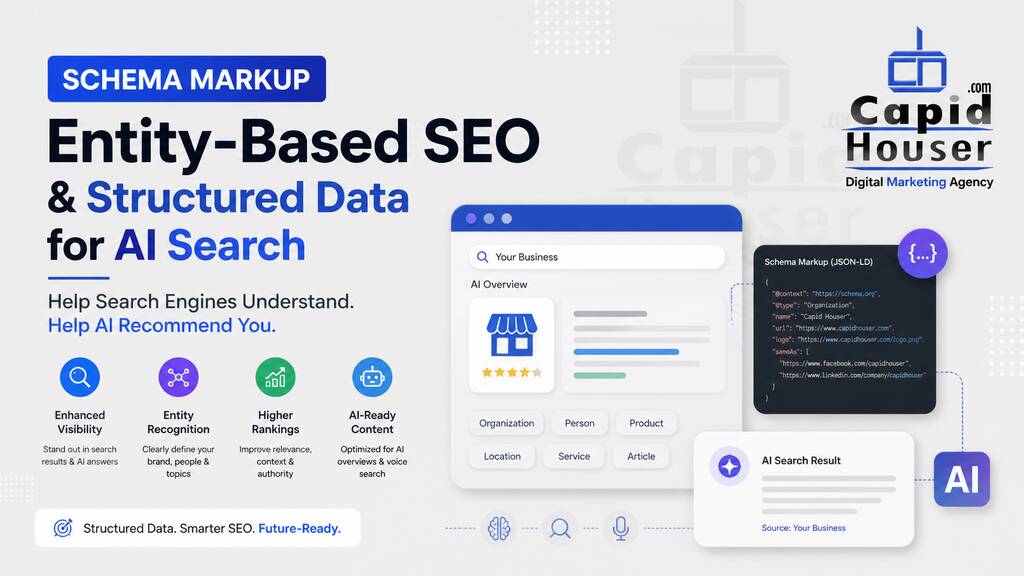
Did you know? Over 90% of all web traffic begins with a search, and in 2024, over half of those search interactions are filtered or shaped by artificial intelligence and structured data. If your business website isn’t optimized for this new era with schema markup – entity based SEO and structured data for AI search, you risk falling behind your competitors—no matter how much you invest in ads or content marketing. In this guide, you’ll discover why schema markup and structured data are now business-critical, and how to take action for lasting visibility in the age of AI-powered search engines.
A New Era: Why Schema Markup – Entity Based SEO and Structured Data for AI Search Now Drives Organic Visibility
Search engines are no longer just about matching keywords—they increasingly rely on AI to understand, interpret, and prioritize information across the web. Modern ai search engines use structured data to build detailed, trustworthy knowledge graphs. This data helps them identify real-world entities—people, brands, products, and organisations—connecting your business directly with relevant customer queries.
Implementing schema markup – entity based SEO and structured data for AI search ensures your website’s information is mapped, structured, and machine-readable. This is what tells search engines not just what your content says, but what it actually means. Businesses who get ahead here quickly see improved rich results, greater prominence in search engine features like knowledge panels, and a noticeable uplift in organic traffic. By applying these strategies—especially with Capid Houser’s Answer Engine Optimization and AI Search service—your business will be positioned to capture the next wave of digital discovery.
“As AI-powered search engines reshape the digital landscape, the way your business is represented in search is now determined by how well your website implements Schema Markup and Entity Based SEO.” — Capid Houser

What You’ll Learn About Schema Markup – Entity Based SEO and Structured Data for AI Search
- Understand the core concepts of schema markup, structured data, and entity based SEO for AI search engines
- Learn the business consequences of ignoring structured data in a world dominated by AI search
- See which schema types and structured data formats are essential in 2024 and beyond
- Discover how to future-proof your website for evolving AI-guided search engine results
- Get actionable steps to optimise your site using Capid Houser’s answer engine and AI search service
The Rise of AI Search Engines and the Power of Structured Data
How AI Search Engines Interpret Web Content With Schema Markup and Structured Data
AI search engines like Google and Bing have transformed the way they index and rank websites. Instead of only crawling raw text, today’s engines leverage structured data embedded in sites using formats like JSON-LD, Microdata, and RDFa. This structured data helps search engines understand the entities on your site and the context surrounding your business, products, or services.
By adding schema markup, you tell search engines explicitly what each page section refers to—be it an event, person, product, review, or organization. These signals equip ai systems with the context required to deliver more relevant, personalized results to every searcher. Tools like Google’s Knowledge Graph use this structured information to feature your business in answer boxes, rich results, and voice search, increasing your organic visibility without extra ad spend.
For businesses looking to implement these technical enhancements effectively, working with a digital marketing partner experienced in structured data can make a significant difference. Discover how a Bristol digital marketing agency approaches digital marketing makeovers to ensure your website is fully optimized for both AI search engines and user experience.

Why Entity Based SEO Matters for Business Owners and Ecommerce Brands
Entity based SEO goes beyond targeting keywords—it’s about ensuring your business itself is recognized as an entity by search engines and AI. When you use schema markup and structured data to clearly define your business, its products, and its relationships, Google and other AI-powered search engines can associate your brand with specific topics, search terms, and customer needs.
For business owners and ecommerce brands, this means higher eligibility for rich results like product cards, review stars, and knowledge panels. These features boost your credibility and attract clicks that would otherwise go to bigger brands or paid ads. By investing in schema markup – entity based SEO and structured data for ai search today, you can future-proof your company against changes in algorithms and maintain strong organic performance.
“Schema markup – entity based SEO and structured data for ai search is an investment in the future visibility of your brand online.” — Capid Houser
Schema Markup – Entity Based SEO and Structured Data for AI Search Explained
What Is Schema Markup and How Does It Work with Search Engines and AI?
Schema markup is a set of standardised tags and code snippets you add to your website so search engines can better understand your content. These tags, developed by Schema. org, create a universal language for ai search engines to identify what your pages actually mean—not just what they say. For example, marking a product with the proper item schema makes it eligible for rich snippets in search results.
This markup is critical as it tells search engines that “apple” on your website is a product, not just a fruit or tech company. When combined with entity-based SEO, schema markup helps search engines build knowledge graphs that connect your business to broader topics and intent-driven searches. Working with solution providers like Capid Houser ensures your schema is precisely mapped to the latest AI requirements.
Structured Data: Types, Formats, and Their Role in AI Search Engines
Structured data is information formatted and organized so that machines, like search engines and AI, can read it effortlessly. The three most widely used structured data formats include:
- JSON-LD (JavaScript Object Notation for Linked Data) – Google’s preferred format for its simplicity and wide support.
- Microdata – Embeds schema directly within HTML elements, useful for more granular needs.
- RDFa (Resource Description Framework in Attributes) – Offers advanced integration for web applications and complex relationships.
Choosing the right structured data format and schema types helps search engines understand your business context, leading to higher chances of appearing in rich results and the Knowledge Graph. Adding structured data appropriately is now essential for any business owner aiming for top rankings in ai search engines.

Entity Based SEO: Connecting the Dots in AI Search for Better Results
The future of SEO is entity-centric. Entity based SEO focuses on representing your business accurately as a unique entity with relationships to other entities—such as products, locations, founders, or services. By marking up your site using schema types, you create structured relationships that AI search engines can catalog and connect instantly.
This approach means that when a potential customer searches for your area of expertise, the search engine doesn’t just look for keywords—it identifies your business as the answer, thanks to data consistency across the web. Capid Houser’s expert implementation ensures your entire digital footprint is unified, accurate, and ready for next-generation ai search.
Why Businesses Must Act Now: The Paradigm Shift in Search Engine Results
“To stay relevant in today’s search environment, brands must move beyond traditional SEO and embrace schema markup – entity based SEO and structured data for ai search.” — Capid Houser
How Schema Markup and Structured Data Influence Rich Results and Knowledge Graphs
Adding structured data to your business website not only increases your eligibility for rich snippets—like reviews, FAQs, and product details—but also makes your site more likely to be featured in AI-powered knowledge graphs. These knowledge graphs pull verified, structured information from across the web, resulting in prominent search visibility, trust signals, and increased organic traffic.
Every new snippet or panel that appears for your business in search results is a direct outcome of how well you’ve mapped your information for AI and search engine algorithms. With Capid Houser’s continuous updates and expert mapping, your company adapts to changes rapidly and maintains a brand presence that stands out.
AI Search Engines vs Traditional Search Engines: Key Differences You Can’t Ignore
Traditional search engines primarily relied on indexing page text and backlinks, returning results based on keyword matches. Modern ai search engines instead prioritize structured data, entity recognition, and real-world context. They interpret intent using natural language processing and the connections built through your site’s schema markup.
Ignoring this shift means you’ll miss out on opportunities to appear in voice search answers, smart assistants, and rich feature boxes—while competitors investing in schema markup – entity based SEO and structured data for ai search capture prime digital real estate.
| SEO Approach | Focus | Search Engine Understanding | Visibility Features | Future Proofing |
|---|---|---|---|---|
| Traditional SEO | Keywords, Backlinks, Unstructured Content | Low – Relies on text parsing | Basic listings, limited to text links | Poor – Vulnerable to AI algorithm shifts |
| Schema Markup & Entity Based SEO | Structured Data, Entity Relationships, Knowledge Graphs | High – Entity-aware and context-driven | Rich results, featured snippets, knowledge panels | Strong – Aligned with AI search evolution |

How Schema Markup – Entity Based SEO and Structured Data for AI Search Impacts Brand Visibility, Trust, and Organic Traffic
Rich Snippets, Rich Results, and the Search Console: Measuring Success
Implementing schema markup and structured data enables your business to qualify for rich results—listings that display additional details such as product ratings, FAQ dropdowns, images, and more, directly in search engine results. This not only increases click-through rates but also conveys authority to customers at first glance. Tools like the Google Search Console and the Rich Results Test let you track which pages are eligible for these features.
By monitoring your site’s performance after adding structured data, you can see measurable improvements—higher impressions, increased organic clicks, and expanded presence in knowledge graphs. This data helps you prove ROI and justifies moving spend from paid search into smarter, future-ready SEO practices recommended by Capid Houser.
Google Search, Entity Understanding, and Your Company Website
Google Search now uses entity understanding as a core part of its ranking algorithms. Instead of simply matching terms, Google interprets the relationships described by your site’s schema markup, linking products, services, founders, and locations into its knowledge graph. If your business is properly marked up, Google delivers richer search snippets, answers in voice search, and higher authority in branded queries.
But without accurate structured data and consistent entity signals, your brand may be overlooked—or worse, misrepresented. Ongoing optimization through schema markup – entity based SEO and structured data for ai search ensures Google and other ai search engines always show your business in its best light. This is exactly where Capid Houser’s expert-led solutions can transform your brand’s online visibility.
Practical Steps: How to Implement Schema Markup – Entity Based SEO and Structured Data for AI Search
- Audit your current site for structured data: Identify existing markup and gaps using tools like Google Search Console or Schema Markup Validator.
- Identify relevant schema types for your sector: Choose schemas that best represent your business—localBusiness, Product, Organization, Event, etc.
- Add/Update schema markup with JSON-LD or Microdata: Follow official schema.org standards and Google’s guidelines for maximum compatibility.
- Test Implementation with Rich Results Test and Search Console: Verify correctness and eligibility for rich results; continuously monitor for schema errors or warnings.
- Monitor, maintain, and adapt as AI search evolves: Stay updated on schema changes and algorithm updates by regularly consulting experts like Capid Houser.

“Most businesses spend on Google Ads without realising that search engines are increasingly powered by entities and structured data. Don’t let your brand get left behind.” — Capid Houser
Industry Examples: Schema Markup, Entity Based SEO, and Structured Data for AI Search by Sector
Ecommerce: Maximising Product Visibility and Rich Results
For ecommerce businesses, schema markup transforms product listings into compelling rich snippets—complete with prices, stock status, and star ratings. Implementing schema types like Product, Offer, and Review ensures that ai search engines feature your products at the top of search results with maximum credibility and click appeal. This structured data helps search engines understand your catalogue at scale, outperforming competitors who rely solely on unstructured content.
With expert implementation, as provided by Capid Houser, product feeds can also be syndicated to shopping platforms, voice search, and Google’s Knowledge Graph, expanding your reach beyond traditional organic listings and securing prime real estate in “zero-click” search experiences.
Corporate Marketing: Enhancing Brand Perception in AI Search Engines
Big brands and marketing teams must think beyond keywords and ads. Using Organization, Brand, and Event schema types, you can define your company’s core identity, founder bios, and critical launch information within structured data. AI-powered search engines like Google use this rich entity context to present your brand in knowledge panels, news carousels, and event calendars.
Adding structured data not only boosts brand trust with authoritative snippets but also signals your leadership and innovation in a marketplace crowded by generic results. Capid Houser’s tailored services ensure these insights are always current and correctly mapped.
Service Businesses: Stand Out in Local and Knowledge Graph Searches
Local businesses—from law firms to restaurants—benefit immensely from LocalBusiness schema and related markup. This data helps search engines understand your address, opening hours, reviews, and specialties. Accurate local structured data ensures your brand is displayed in map packs, “near me” searches, and AI-powered assistants.
What sets your business apart is not only presence, but entity accuracy—being recognized as the definitive provider in your niche, region, or specialty by every major ai search engine. Capid Houser’s local and knowledge graph strategies can push your business to the forefront of these vital results.

Common Challenges When Adopting Schema Markup and Structured Data for AI Search
- Choosing the right schema types for your industry or business model
- Ensuring data consistency and accuracy across all digital properties
- Keeping pace with evolving search engine and AI requirements
People Also Ask: Schema Markup – Entity Based SEO and Structured Data for AI Search FAQs
What is structured data and why is it important for AI search engines?
Structured data is a standardized format that organizes information on your website so search engines and AI systems can read and interpret it accurately. It’s important for ai search engines because it helps search engines understand your offerings, relationships, and context, making your content eligible for rich results like knowledge panels and interactive snippets. This improves organic visibility and trust.
How does entity based SEO differ from traditional SEO?
Traditional SEO focuses mainly on keywords and backlinks, hoping to capture search visibility. Entity based SEO, on the other hand, emphasizes defining your business as a unique entity within the broader web ecosystem. This connects your brand to relevant concepts and relationships, allowing AI-powered search engines to recognize and feature your company more effectively in various search experiences.
What are the top schema types every business should implement?
At a minimum, every business should use Organization or LocalBusiness schema for company details, Product or Service schema for offerings, Review and FAQ schema for trust signals, and Breadcrumb schema for navigational clarity. Selecting the right schema types ensures your business is comprehensively mapped in ai search engines.
How can companies measure the benefits of schema markup – entity based SEO and structured data for AI search?
Track performance using tools like the Google Search Console, which provides data on impressions, clicks, and eligibility for rich results. The Rich Results Test tool shows which pages feature enhanced snippets. Over time, companies see more prominent search features, increased organic traffic, and improved user engagement. These metrics serve as direct proof of the value that schema, entities, and structured data deliver.
Key Takeaways: Schema Markup – Entity Based SEO and Structured Data for AI Search for Companies
- AI is transforming the way search engines understand and display information
- Schema Markup and Entity Based SEO are now business-critical strategies
- Structured data directly impacts how your brand is perceived and found online
- Working with experts like Capid Houser gives your business a competitive advantage in answer engine and AI search
Take the Next Step in AI Search: Get Started With Schema Markup – Entity Based SEO and Structured Data For Your Business
“To learn more about The Complete Answer Engine Optimization And AI Search Service For Companies … visit https://www.capidhouser.com/answer-engine-optimization-and-ai-search/“
Don’t let your competitors take the lead. Schema markup – entity based SEO and structured data for AI search are essential to future-proof your brand, secure top visibility, and unlock the full potential of AI-driven discovery. Get a tailored strategy from Capid Houser today and transform your digital footprint for the AI era.
Conclusion
The age of AI search is here: equip your business website with schema markup, entity based SEO, and structured data to lead in this new search landscape.
If you’re ready to take your digital presence to the next level, it’s worth exploring how a holistic digital marketing makeover can amplify the impact of your structured data and entity-based SEO efforts. By integrating advanced schema strategies with a comprehensive approach to online marketing, your business can achieve sustainable growth and stand out in an increasingly AI-driven marketplace. For a deeper dive into transforming your brand’s visibility and performance, discover the full range of services offered by a leading digital marketing agency in the UK—and unlock new opportunities for your business in the digital era.
Sources
- https://www.capidhouser.com/answer-engine-optimization-and-ai-search/ – Capid Houser: Answer Engine Optimization and AI Search Service
- https://developers.google.com/search/docs/appearance/structured-data/intro – Google Search Central: Introduction to Structured Data
- https://schema.org/ – Schema.org Documentation
- https://moz.com/learn/seo/schema-structured-data – Moz: Schema and Structured Data for SEO
- https://searchenginejournal.com/seo-guide/schema/ – Search Engine Journal: Schema Markup & Structured Data for SEO
To enhance your understanding of schema markup, entity-based SEO, and structured data for AI search, consider exploring the following resources: “Entity-Based SEO for Advanced Search | Schema App Solutions”: This article delves into how entity-based SEO moves beyond traditional keyword strategies by focusing on defining entities and their relationships, thereby improving search engine understanding and relevance. (schemaapp. com) “Structured Data for AI Search: Complete Schema Markup Guide (2026)”: This guide provides a comprehensive overview of implementing structured data to enhance AI search visibility, emphasizing the importance of schema markup in improving content comprehension by AI systems. (stackmatix. com) By exploring these resources, you’ll gain deeper insights into effectively implementing schema markup and structured data to optimize your website for AI-driven search engines.
